Skip to content
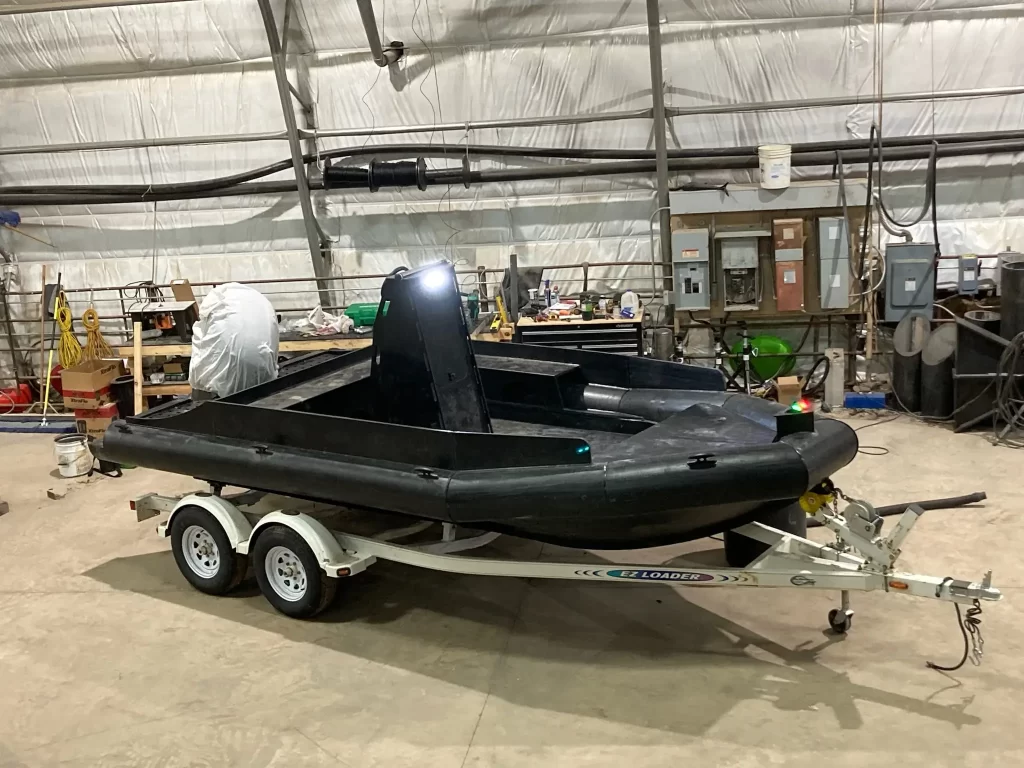
HDPE boat building is fundamentally different from fiberglass or aluminum construction. If you’re buying a boat built to last a lifetime, you should know exactly how it’s made. Here’s what happens from the moment we pull reclaimed HDPE pipe out of the ground to the moment your boat is ready to hit the water.
Our Process
Step 1: Reclaiming and Prepping the HDPE Pipe
Legacy’s process begins with reclaimed HDPE pipe. Once transported to the facility, each pipe is:
- Inspected for embedded debris (concrete, wood, or metal) that could damage processing machinery
- Pressure-washed externally and cleaned internally with a sewer-jetter pressure washer
- Dried using industrial fans before processing
With the pipes now thoroughly cleaned, they can make their way to two machines that will shred and then granulate them into similarly sized HDPE chips.
Step 2: Extruding the HDPE Sheets
The HDPE chips are melted and extruded into flat sheets, typically 0.0625–1 inch thick and 48 inches wide. Sheet length is determined by the boat’s dimensions. Extruding in-house rather than purchasing pre-made sheets has three key advantages:
- No contamination from post-consumer plastic blends.
- No lateral seams because the sheets run the full length of the hull.
- We can extrude welding wire that is a perfect match for our sheets at the same time, ensuring much stronger welds.
Step 3: Cutting and Fitting the Final Design
Your design goes from CAD file to CNC router. Every hull panel and component gets cut to exact dimensions, then it’s all tack-welded into position.
Before we run the final weld, every seam gets abraded with a rotary burr or wire wheel. HDPE oxidizes when it hits air, and welding over that layer produces a weaker joint. This step is non-negotiable.
Step 4: Welding the HDPE into a Solid, Watertight Vessel
The only way to join the panels permanently is extrusion welding, which is exactly what we use.
A handheld extrusion welder melts our matched welding wire at 210–300°C and injects it into the joint while softening the edges of the base sheets at the same time. When it cools, the materials fuse into one continuous bond. There’s no adhesive to fail, no mechanical fastener to corrode. Just plastic fused to plastic.
Once the hull is welded, the real structure goes in. HDPE ribs and stringers get welded to the floor of the hull for rigidity. Buoyancy compartments are built in. Then the deck, seating, and consoles are custom-cut and welded directly onto the hull.
Step 5: Finishing Touches
The final stage of building an HDPE boat is one of the most satisfying to watch.
Any excess bits of HDPE from the welding process are shaved away with simple woodworking tools, and what’s left is a boat that should stay as sharp as the day it was made without any maintenance routines built around keeping a painted or treated surface alive.
One More Method Worth Knowing
For smaller, mass-produced boats (kayaks, canoes, and small tenders), manufacturers often use rotational molding instead.
Granulated HDPE is heated and placed into a metal mold that rotates on multiple axes while the plastic melts and coats the interior, resulting in a seamless one-piece hull. Unfortunately, it’s not really a process that works for custom builds or larger projects.
If you’re looking for a boat built from the ground up to last, with no hidden maintenance costs and no compromises in the build, you can browse our catalog or reach out to talk through a custom design.
And if you’re curious about the Legacy team’s process, you can watch it here.