Skip to content
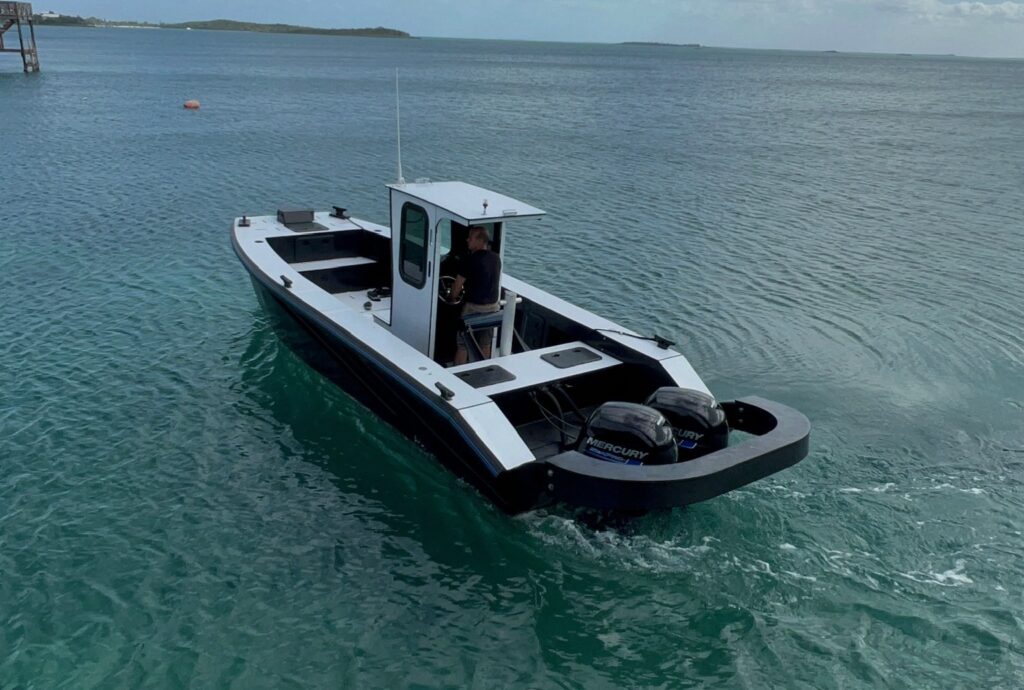
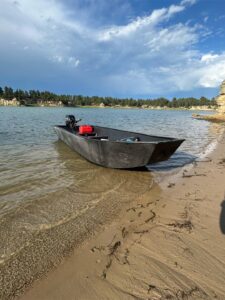
Lightweight HDPE jon boats are designed to flex.
What Deflection Is and Why Lightweight Boats Flex
Hull deflection is the amount a hull deforms or flexes under load or when encountering water movement. The question is how much flex occurs and whether it is engineered or accidental.
In lightweight boats, flex is intentional. Rather than resisting every load through rigidity alone, the hull can distribute stress across the structure rather than concentrating it at isolated points.
One goal in lightweight boat design is to reduce weight. A lighter boat needs to displace less water to float, which can help reduce draft and improve efficiency. Reducing material can also reduce rigidity, which means the hull needs to be engineered differently to handle loads and water impacts.
HDPE’s material properties enable a different approach. The plastic is viscoelastic, meaning it can deform and recover under load. Combined with the geometry of Legacy’s interlocked hull, this allows the structure to flex under impact rather than transmitting all of the resulting forces through a rigid structure.
Mechanical Interlock Construction Supports Flex
Legacy builds HDPE boats using mechanical interlock construction based on CAD-designed geometry. Welds seal and reinforce those locked joints, creating a continuous structure rather than relying on discrete mechanical fasteners. This approach allows the hull to flex while maintaining the integrity of the interconnected panels.
By comparison, riveted construction relies on individual mechanical fastening points to join panels. Those joints have different load paths and may require maintenance over time, particularly if fasteners loosen or seams develop leaks. With Legacy’s welded interlock construction, the hull panels work together as an integrated structure rather than relying solely on individual fastening points.
Flex vs. Rigid: Different Purposes, Different Designs
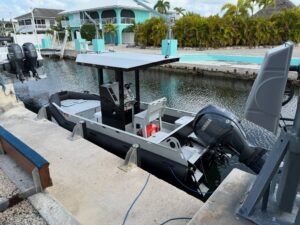
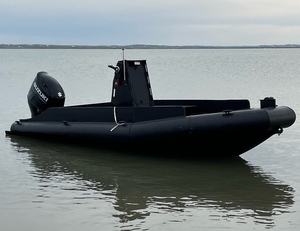
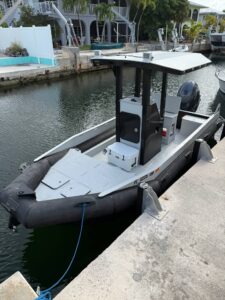
Not all boats are designed for the same operating conditions. Legacy’s Lena series illustrates how HDPE can be used across different applications, from patrol and inspection to light commercial transport and sustained operations in challenging conditions. The L820, for example, combines a wide beam with a high load rating for demanding work.
On the other hand, a lightweight fishing boat is designed to operate in shallow water, maneuver through tight spaces, and carry anglers and fishing equipment efficiently. For that application, controlled hull flex can be part of the design rather than a sign of structural weakness.
Aluminum fishing boats offer a different feel. They are generally more rigid than lightweight HDPE jon boats, which some anglers may prefer. However, they also generally weigh more, which can affect draft and shallow-water performance.
What Riders Actually Experience
In real-world fishing, what does flex mean? A few things:
First, the ride: a lightweight HDPE boat running through chop can feel different from a rigid aluminum hull. The controlled give in the hull can soften the feel of some impacts, although ride quality also depends on hull shape, speed, loading, and water conditions.
Second, responsiveness: the hull can respond to changes in water conditions and acceleration, with some flex at the transom as you accelerate. Some anglers prefer this; others prefer the more locked-in feel of a rigid structure. Both are legitimate preferences.
Safety and Structural Integrity
Flex does not mean structural failure. The important distinction is between controlled flex within the hull’s intended operating range and excessive deformation caused by overloading, impact, or operating conditions beyond the boat’s design parameters. Like any boat, a lightweight HDPE jon boat needs to be operated within its rated capacity and intended conditions.
The Bottom Line
If your lightweight HDPE jon boat feels like it flexes, that doesn’t necessarily mean something is wrong. Controlled flex is part of the design.
For anglers who prioritize low weight and shallow-water performance, that difference can be an advantage rather than a weakness.