Skip to content
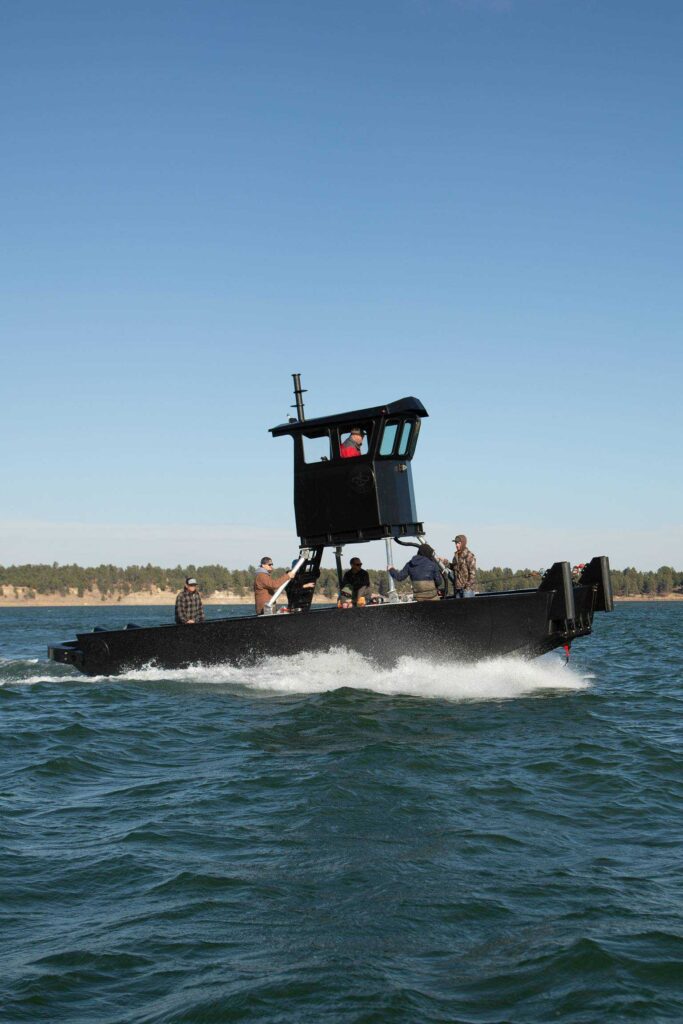
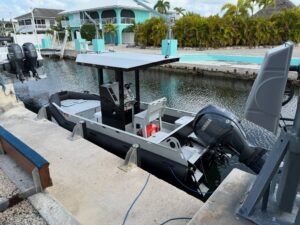
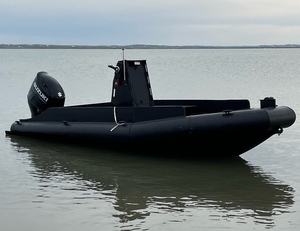
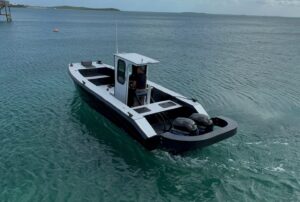
The Wyoming Game and Fish Department (WGFD) manages over 800 species of wildlife across one of the most geographically demanding patrol territories in the American West. Game wardens operate across eight regional jurisdictions, covering systems from the Snake River corridor in Teton County to the Bighorn Basin and the high country reservoirs along the Montana line. [1] When those wardens need watercraft, the conventional choices, welded aluminum and fiberglass, fail in specific and costly ways. A game warden boat built from HDPE closes those gaps directly.
Wyoming Game Wardens’ Responsibility While on the Water
Watercraft patrol is a formal part of every Wyoming game warden’s job description. [4]
Wardens enforce and check compliance with hunting, fishing, trapping, and watercraft statutes. They also conduct courtesy and compliance watercraft safety inspections, verify Hull Identification Numbers, check Aquatic Invasive Species (AIS) certification, and respond to injured wildlife calls in riparian zones that can only be accessed by water. [2]
The Cody Region alone runs a patrol corridor from the Montana state line south to Boysen Reservoir, and from Yellowstone National Park east to the west slope of the Bighorn Mountains. That is not a small beat. [1]
The WGFD’s Wildlife Habitat Management Areas include nearly 225 miles of streams and more than 21,000 lake surface acres. [3] Wardens patrol those waters season to season, in conditions that change fast and aren’t kind to boats that require a trailer trip to a yard every time something goes wrong.
Why HDPE Boats Fit WGFD Procurement Reality
State agency procurement for law enforcement and conservation watercraft runs through a different set of criteria than recreational or commercial boating. Lifecycle cost, maintenance burden, and field repairability carry more weight than aesthetics or speed. A game warden boat made from HDPE scores well on all three.
The Remote Waterway Problem
The core operational challenge is distance from support. A warden on the upper Snake River, or working the shoreline on Yellowstone Lake at 7,732 feet above sea level, is not close to a boat repair facility. [5]
Aluminum hulls exposed to a rocky Wyoming channel can develop cracks or deformations that require welding equipment and controlled conditions to fix correctly.
Fiberglass can fracture on the same rocks, and patching in the field with cold hands in late September is not a reliable repair.
HDPE changes that equation. The material can be welded in the field with a propane torch and basic rod stock. A warden with a few hours and the right rod can fuse a damaged section back to structural integrity without trailering the boat to a shop. That keeps a game warden boat on patrol rotation instead of sitting in Gillette or Cody waiting for a welder.
Shallow Draft in Wyoming’s Rocky Channels
Wyoming’s rivers are not deep. The Bighorn River runs through boulder strewn channels in its upper reaches. The Snake picks up debris and submerged logs during spring snowmelt runoff, when water temperatures can stay below 50 degrees Fahrenheit and the current runs fast enough to require serious maneuvering. The North Platte carries significant sediment loads and runs shallow in its regulated tailwater sections below Pathfinder and Seminoe.
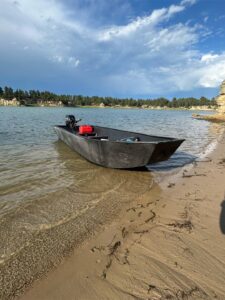
HDPE hulls are built with shallow drafts and can take a hard bottom contact that would split a fiberglass hull or fold an aluminum sponson. The material absorbs impact and rebounds. There are no gel coat surfaces to fracture and no welded seams to crack open when the bow drops hard onto a submerged rock at patrol speed.
No Corrosion, No Anodes, No Maintenance Schedule
Wyoming game wardens are not in the business of hull maintenance. They are in the business of wildlife and watercraft enforcement. [2] Aluminum hulls oxidize and pit, particularly in the high mineral content water common to Wyoming’s reservoir systems. Fiberglass hulls blister, require bottom paint, and develop osmotic damage over time.
HDPE is inert. It does not react with the mineral heavy water found in Boysen Reservoir or the saline tinged water in some of the state’s high desert impoundments. There are no anodes to replace, no bottom coatings to reapply, and no fiberglass weave to delaminate. The hull on a game warden boat that goes in the water in May looks the same when it comes out in October.
That matters for a department managing fleet assets on a state budget. The total lifecycle cost of an HDPE wildlife patrol vessel in Wyoming runs substantially lower than either aluminum or fiberglass over a ten year ownership period, once haul outs, repairs, and corrosion treatment are factored in. [1]
Elevation and Temperature Loading
Yellowstone Lake sits at 7,732 feet. Ice coverage on the lake reaches nearly three feet thick in winter. [5] Jackson Lake, in Grand Teton National Park, sits at 6,772 feet and averages below 60 degrees Fahrenheit even at the height of summer. [6] Wardens working these systems face thermal stress on boats and equipment that would not be encountered at lower elevations.
HDPE is stable across a wide temperature range without the brittleness issues that affect fiberglass in freeze thaw cycles. HDPE does not absorb water, so there is no internal moisture to freeze and expand in a hull that sits on the trailer overnight at altitude. That matters for a game warden boat operating on a year round schedule in a state where the seasons at 7,000 feet are compressed and unforgiving.
For a department running patrol operations across 225 miles of managed stream access and 21,000 acres of managed lake surface, the maintenance free nature of an HDPE hull is not a convenience. [3] It is an operational necessity.
If you’re wanting to make the switch to an HDPE vessel too feel free to give the Legacy team a call or check out our catalog.
Sources
[1] Wyoming Game and Fish Department. “2024 Law Enforcement Report.” https://wgfd.wyo.gov/news-events/game-and-fish-releases-2024-law-enforcement-report
[2] Wyoming Game and Fish Department. “Enforcement.” https://wgfd.wyo.gov/enforcement
[3] Wyoming Game and Fish Department. “Wildlife Habitat Management Areas.” https://wgfd.wyo.gov/Public-Access/WHMA
[4] Wyoming Game and Fish Department. “Game Warden Recruitment Process.” https://wgfd.wyo.gov/game-warden-recruitment-process
[5] Wikipedia. “Yellowstone Lake.” https://en.wikipedia.org/wiki/Yellowstone_Lake
[6] Wikipedia. “Jackson Lake (Wyoming).” https://en.wikipedia.org/wiki/Jackson_Lake_(Wyoming)