Skip to content

Procurement Guide · Search & Rescue
HDPE Search and Rescue Boats: A Procurement Specification Guide
The SAR vessel specification that makes the boat available when the call comes in.
Hull and structural design. Self-righting and reserve buoyancy. Rescue platform geometry. Mission equipment mounts. Field repair in the middle of a deployment. What marine SAR commanders, fire chiefs, sheriff marine units, and federal contracting officers should put in the RFP, and what the specification framework should actually require.
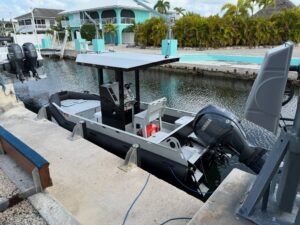
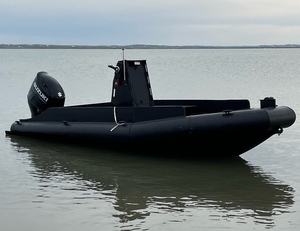
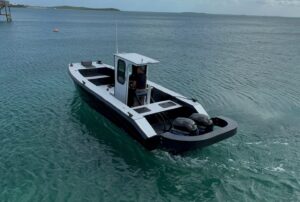
A search and rescue boat lives most of its service life tied to a dock, fueled, and waiting. The capability that matters is availability on the day a call comes in, in the weather the call comes in. The hull material specified at the RFP stage decides whether the vessel is ready in year ten, year fifteen, and year twenty, and how often it is out of service for corrosion, repair, or refit. High-density polyethylene has matured into a credible specification for the SAR class, and the framework below is what an authority having jurisdiction should evaluate it against.
Context
Where HDPE fits in the SAR fleet conversation
Marine SAR in the United States is not one program. The U.S. Coast Guard is the federal Search and Rescue Coordinator for the maritime regions under the 2016 National SAR Plan, and operates the standardized Defender-class Response Boat–Small (RB–S) and Response Boat–Medium (RB–M) fleets out of stations across the coast and Great Lakes.1, 2 Inland and coastal SAR below the federal layer is carried out by a much larger and more fragmented set of agencies: county sheriff marine units, municipal fire department marine divisions, state park and natural resource agencies, tribal patrol, mutual aid task forces, and volunteer SAR organizations operating under cooperative agreements with the National Park Service, the Coast Guard Auxiliary, and state emergency management offices.
The federal fleet is built around welded aluminum hulls. The Defender-class RB–S and the newer RB–S II are aluminum with foam-collar sponsons. The 45-foot RB–M is a deep-V aluminum hull with twin waterjets.2, 3 Aluminum is a sound choice for the federal mission profile, where the Coast Guard maintains a centralized depot maintenance system, dedicated boat technicians, and a yard infrastructure that can absorb the corrosion management and welding repair load.
The state and local layer operates without that infrastructure. A volunteer fire department marine division with two boats and a part-time mechanic does not run a depot maintenance cycle. A county sheriff marine unit posted at a remote lake or river system does not have a contracted welding shop on retainer. For these agencies, the question that determines fleet availability is not whether the hull material can be repaired, it is whether it can be repaired by the unit’s own people, on the unit’s own ramp, between deployments.
That question is what brings HDPE into the SAR conversation. HDPE patrol and rescue hulls have been specified by European coast guards, fire and rescue services, and harbor authorities for more than a decade, with documented service in tropical, temperate, and Arctic waters and reported top speeds above 30 knots in the patrol class.4 The same engineering case applies to the U.S. domestic SAR market, particularly for the layer of agencies operating below the federal fleet.
What follows is the procurement framework. It is structured the way a SAR boat RFP should be structured. Hull, structural design, and reserve buoyancy first. Deck, console, and rescue platform geometry second. Mission equipment mounts third. Propulsion fourth. Then compliance and documentation, the field repair case, the procurement vehicles that actually fund these acquisitions, and the lifecycle cost comparison across a fleet. The framework references our broader workboat program and the rigid-hull HDPE configurations Legacy builds, but the specification language is portable to any qualified HDPE builder.
The Framework
The SAR procurement specification framework
A SAR-class HDPE RFP should specify the five categories below. Each bullet describes what the section needs to define, written at the level a contracting officer or fire chief can lift into agency procurement language without further translation from naval architecture.
Hull material, thickness, and reserve buoyancy
Specify the polyethylene grade as high-density polyethylene with a minimum 2 percent carbon black UV stabilization package. Specify the nominal hull plate thickness. Most SAR-class HDPE hulls in the 18 to 30 foot range run 20 to 30 mm on the bottom, 12 to 20 mm on the topsides, and 10 to 15 mm on the deck plate.
The structural arrangement should be defined in the specification rather than left to the builder. HDPE SAR hulls are typically built from CNC-machined sheet, extrusion-welded into a transversely and longitudinally framed structure with sealed compartments for reserve buoyancy. Require the manufacturer to disclose the compartmentalization scheme, the calculated reserve buoyancy in cubic feet, and the design standard followed. ISO 12215 (small craft hull construction) and ISO 12217 (small craft stability and buoyancy) are the standard references for vessels in the SAR length range.5
For surf and offshore SAR roles, the RFP should specify positive flotation sufficient to keep the vessel afloat with the cabin flooded and full crew aboard, and should require either a sealed cabin self-righting design or a foam-collar sponson treatment integrated to the hull. Self-righting capability is not standard across the SAR class and should be called out explicitly when the mission profile requires it.
Deck, console, and rescue platform geometry
The SAR deck does work the patrol deck does not. The specification should call out static deck load, working deck clear area in square feet, freeboard at the recovery point, transom door or low-freeboard recovery station configuration, Stokes basket or backboard stowage location, and the access geometry for in-water victim retrieval.
Low freeboard at the recovery point conflicts with high freeboard for offshore seakeeping. The RFP should resolve this by specifying either a dedicated dive door, a hinged transom panel, or a recovery platform aft of the engine well. Each has a different impact on the structural arrangement and should be specified before contract award, not negotiated as a change order.
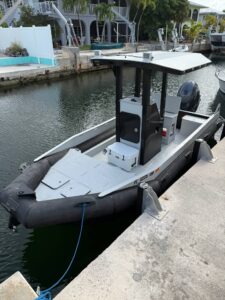
Console configuration belongs in this section. Open console, partial T-top, full pilothouse, and forward cuddy cabin are the four common SAR arrangements. The choice drives crew capacity, all-weather capability, sensor and electronics mounting space, and crew thermal protection on multi-hour search patterns in cold water.
Mount points for SAR mission equipment
SAR boats carry a mission equipment load that often exceeds patrol-class equipment by mass and complexity. Radar, FLIR or thermal imaging, side-scan or downward-imaging sonar, searchlights and pencil-beam spotlights, marine VHF and 800 MHz public safety radios, AIS transceiver, light bar and siren, dive flag mount, dewatering pump deck pad, and a deck-mounted A-frame or davit for surface swimmer recovery and stretcher handling.
With HDPE, structurally reinforced mount points are handled by through-bolting to backing plates of solid HDPE bar stock fused into the structure, or by stainless steel reinforcement plates bonded and through-bolted at the mount station. The RFP should list every piece of mission equipment that requires a mount, with weight and force-vector expectations for each, and require the manufacturer to detail the reinforcement strategy. The dewatering pump pad and the davit footprint are the highest-load items on most SAR builds and warrant explicit specification language.
For agencies with multi-role marine units that also carry fire suppression capability, the RFP should specify the monitor mount footprint, the structural reinforcement under the pump skid, and the through-hull arrangement for the dedicated draft line. This is a build category where the disagreement between procurement officers and builders concentrates and where the specification language has the most leverage.
Propulsion, steering, and redundancy
HDPE hulls accept the full range of SAR propulsion: outboard (single or twin), inboard diesel with shaft and propeller, sterndrive, and waterjet. Match the propulsion to the mission profile.
Shallow-water and debris-field SAR (riverine, flood response, lake systems with submerged hazards) favors waterjet or jet outboard, where the absence of an exposed prop reduces foul-out and strike damage. Open-water and offshore SAR favors twin outboards or twin inboard diesel for redundancy on a long search pattern far from the station. Surf and breaking-wave SAR favors waterjet with a deep-V hull and self-righting cabin.
For SAR work, redundant propulsion is not a luxury. The RFP should default to twin engines for any vessel operating beyond the harbor mouth, with the single-engine configuration justified only for protected-water roles. Specify the engine make, horsepower, fuel type, fuel capacity, and the expected range at search speed (typically 8 to 12 knots) rather than only at top speed. Search endurance, not sprint speed, is what determines the boat’s effective coverage on a real mission.
Compliance, documentation, and operator training
The specification should require, at minimum: manufacturer certification to the design standard referenced under Item 01, a hull and structural drawing package, a stability booklet appropriate to the vessel class, a maintenance and repair manual that includes the field welding procedure for HDPE (see the next section), and a parts and consumables list for the propulsion and electrical systems.
For vessels built for federal procurement or federally funded state and local procurement, the specification should include Buy American Act compliance language and, where applicable, Build America, Buy America provisions of the Infrastructure Investment and Jobs Act. A U.S.-built HDPE hull, fabricated from domestically extruded sheet, satisfies both regimes.
For SAR vessels under 65 feet operated for compensation or under federal authority, applicable U.S. Coast Guard construction standards (33 CFR Part 183 for recreational-derived hulls, NVIC and Subchapter T for inspected vessels above the threshold) should be cited where they apply. The specification should require the builder to deliver an operator familiarization course and a hull-repair training package for unit personnel at delivery.
Operational Case
Impact, debris, and the SAR deployment environment
Patrol boats spend most of their hours in open water at speed. SAR boats spend a disproportionate share of their hours at low speed, in close proximity to fixed objects (docks, pilings, rip-rap), in debris fields (flood response, post-storm SAR, mass-rescue operations), and on rough launches and recoveries in conditions that would keep a recreational boat ashore. The hull is the part of the asset most likely to be damaged in normal service, and the damage profile is impact, abrasion, and grounding rather than corrosion alone.
HDPE responds to this profile differently than aluminum or fiberglass. The material is ductile under impact rather than brittle. A hard contact with a piling, a submerged log, or a partially submerged vehicle in a flood response will deform the plate locally rather than crack it. The energy of the strike is absorbed by the elastic and plastic deformation of the polymer, and most strikes that would put a comparable aluminum hull on the trailer leave an HDPE hull on the water.
Field Note
The most common in-service damage on a SAR hull in volunteer and small-municipal service is not corrosion. It is impact, grounding, and abrasion from training drills, launches in heavy weather, and contact with floating debris during actual deployments. The hull material that absorbs that damage without immobilizing the asset is the hull material that produces the highest mission availability across the service life.
UV exposure on a SAR hull is the other operational stress that compounds across the service life. HDPE built with carbon black UV stabilization (the standard 2 percent loading specified above) is protected through the bulk of the material, not by a surface coating that requires recoating on a multi-year cycle. The detail on UV behavior in carbon-stabilized recycled HDPE, including the long-duration testing protocols (ASTM D4329 and ASTM D2565), is covered in our reference on why HDPE boats hold up under sunlight.
Field Repair
Repair availability and mid-deployment serviceability
SAR deployments are not one-incident events. Hurricane response, regional flood response, major water rescue task force activations, and mutual aid deployments away from the home station can run a SAR boat for days or weeks at a stretch, in conditions that produce minor and moderate hull damage that would normally send the boat home. A hull that can be repaired at the deployment site, by the operating unit, between calls, is a hull that completes more missions per activation.
HDPE is repaired by plastic welding. Hand-held extrusion welding is the primary technique for structural repair of sections over 6 mm thick. The extrusion welder draws HDPE rod into a heated barrel, plasticizes it, and extrudes the molten polymer into a prepared joint while a hot-air jet softens the parent material to allow fusion.6 Hot-air welding handles thinner sections and finish work. The result is a homogeneous weld of the same polymer as the parent material, with strength approaching the base material when properly executed.
The practical implications for a SAR unit are direct. A field welding kit fits in a single tote and lives in the response trailer. A two-day training course produces a competent unit welder. A crack from a hard grounding on a flood debris field, a hole from a piling strike on a night launch, an impact deformation from contact with a partially submerged vehicle during a high-water rescue: all are repairable in place. The boat does not leave the deployment.
The aluminum equivalent on the same incidents requires TIG welding by a certified welder, often with hull cleaning to bare metal and repainting of the affected area. For a unit operating away from its home station, that means either trailering the boat out of the deployment or accepting the asset as out of service until a certified welding shop becomes available. The broader argument for the structural case for HDPE in working service is laid out at heavy-duty plastic boats.
Contracting
How SAR boats actually get funded and acquired
FEMA Assistance to Firefighters Grant (AFG)
The Assistance to Firefighters Grant program, administered by FEMA, is the primary federal grant pathway for fire department marine units acquiring SAR-capable boats. Vehicle Acquisition is the relevant activity category. The 2019 program guidance explicitly lists fire boats over 20 feet as an eligible acquisition under Vehicle Acquisition, with related marine firefighting and water rescue training eligible under Operations and Safety.7 AFG funding has supported hundreds of marine acquisitions across fire and rescue services since the program’s inception.
Port Security Grant Program (PSGP)
The Port Security Grant Program, also administered by FEMA, funds response vessels for port and waterway agencies under DHS port security authorities. For Fiscal Year 2025, DHS allocated $90 million to the program, and FEMA data shows the program awarded $88.2 million across 306 projects to acquire or maintain response vessels in recent years.8, 9 The PSGP has funded a substantial portion of the U.S. multi-role fireboat fleet, including vessels at Savannah, Duluth, East Providence, Clark County, and the New York / New Jersey regional fire boat task force.10
GSA Schedule 84 and FAR Subpart 8.4
For federal direct procurement and for state and local cooperative purchasing under the Local Preparedness Acquisition Act, GSA Multiple Award Schedule 84 (Total Solutions for Law Enforcement, Security, Facilities Management, Fire, Rescue, Clothing, Marine Craft and Emergency/Disaster Response) is the standard vehicle. Marine Craft and Equipment sits under Federal Supply Group 19 within Schedule 84. Federal ordering under Schedule contracts follows Federal Acquisition Regulation Subpart 8.4, with award on best value to the agency.11
State and tribal procurement and mutual aid pools
State boating law administrator programs, state homeland security pass-through grants, and tribal SAR funding through the Bureau of Indian Affairs round out the funding picture. Many states operate mutual aid equipment pools that allow regional task forces to share procurement vehicles, which can compress the administrative path for a smaller agency acquiring its first marine SAR asset.
Total Cost
Fleet cost categories across the SAR service life
SAR agencies typically operate fleets of two to twelve vessels, replaced on a rolling cycle, and track availability across a multi-decade horizon. The cost categories below are the ones HDPE affects most. The argument is narrower than a blanket recommendation: aluminum hulls remain a sound choice for many SAR roles, particularly federal direct-acquisition fleets with depot maintenance infrastructure. For agencies operating in corrosive water, away from a yard, and tracking total cost of ownership across the service life, the HDPE comparison is worth running.
| Cost category | Aluminum SAR hull | HDPE SAR hull |
|---|---|---|
| Corrosion management | Sacrificial anode inspection and replacement on a 6 to 18 month cycle. Bottom paint maintenance. Fastener isolation. Saltwater rinse program after every launch. | None required. Hull is dielectric and inert in saltwater. Visual inspection only. |
| UV and surface protection | Topside paint and gel-coat oxidation management. Repaint cycle in multi-year intervals. | Carbon black UV stabilization distributed through the bulk material. No surface coating to maintain. |
| Impact and grounding repair | TIG welding by certified personnel. Often requires haul-out, shop time, and repaint of affected area. | In-place extrusion welding by trained unit personnel. Hours, not weeks. Boat can return to deployment. |
| Mid-deployment serviceability | Limited. Asset typically returns to home station or contracted yard for repair. | Field welding kit travels with the unit. Repairs completed between calls during sustained deployments. |
| End-of-service disposal | Scrap aluminum recovery, with paint and coating remediation. | Hull material is recyclable polyethylene. No coating to remediate. |
| Fleet availability driver | Constrained by yard schedule and certified welder availability. | Constrained by in-house technician availability, which the agency controls. |
Aluminum and rigid-hull inflatable construction will remain the right answer for many SAR missions, particularly at the federal scale. The argument here is narrower. For state and local agencies, fire department marine divisions, sheriff marine units, tribal SAR programs, and volunteer task forces, the procurement question is not which hull material is best in the abstract. It is which hull material produces the highest mission availability across a multi-decade service life when the agency does not have its own boat yard. The HDPE specification framework above is the one the RFP should evaluate against agency requirements.
Legacy HDPE builds SAR-capable hulls from recovered and recycled high-density polyethylene, extruded into sheet stock in-house and fabricated to specification at the Wyoming facility. See the broader workboat program, the workboats available now, the rigid-hull HDPE configurations, and the custom build program. For agencies running a formal procurement, the Legacy team can supply specification language, structural and stability references, and pricing aligned to the contracting vehicle the agency uses.