Skip to content

Aluminum has been the default material for U.S. commercial workboats for decades, and for good reason: it is light, weldable, and well understood by the country’s shipyards. But every aluminum hull has a finite service life, and most operators wait too long to retire one. The cost of running a fatigued hull — in downtime, fuel, weld repairs, and crew safety — almost always eclipses the cost of replacement long before the boat is pulled from service.
If you manage a fleet of utility vessels, patrol boats, survey craft, or harbor workboats, the question is rarely whether to replace an aging aluminum hull. It is when. Here is how to read the signs.
1. Recurring Crevice and Galvanic Corrosion
Aluminum’s natural oxide layer protects it well in clean conditions, but real-world workboats live in salt spray, brackish water, fuel residue, and contact with dissimilar metals. Once corrosion starts at a weld toe, under a deck fitting, or behind a foam-filled compartment, it tends to accelerate.
The Association for Materials Protection and Performance (formerly NACE International) has documented that corrosion costs the U.S. economy roughly $276 billion annually, with marine assets among the most affected categories. For aluminum workboats specifically, the failure mode is usually pitting that progresses into the heat-affected zones around welds — the very joints that hold the hull together.
If your yard is grinding out and re-welding the same areas every haul-out, the hull is telling you something. Localized repairs do not restore the parent metal’s grain structure, and each weld pass introduces new heat-affected zones that are themselves more corrosion-prone. The U.S. Naval Research Laboratory’s work on marine alloys confirms that repeated thermal cycling progressively degrades aluminum’s mechanical properties in welded structures.
2. Hull Plating Below Class or USCG Minimum Thickness
Ultrasonic thickness gauging is the single most useful diagnostic tool an operator has. Most aluminum workboats are built to 3/16″ or 1/4″ bottom plate. Once measured thickness drops more than roughly 20% below the original scantling — or below whatever minimum your classification society or insurer specifies — the hull is no longer the boat you bought.
For inspected vessels, the U.S. Coast Guard’s Commercial Vessel Compliance program sets explicit thresholds, and falling below them does not just mean a failed inspection — it means the structural margins the naval architect designed in have already been consumed. Even for uninspected commercial vessels, insurers increasingly require gauging reports before renewal.
3. Fatigue Cracking at Stress Concentrations
Aluminum, unlike steel, has no true fatigue limit. Every load cycle — every wave slam, every crane lift, every trailer bounce — consumes a fraction of the hull’s remaining life. The American Bureau of Shipping’s structural rules and broader ABS guidance documents treat aluminum fatigue as a design-life calculation, not a margin-of-safety calculation.
What this looks like in service: hairline cracks radiating from chine knuckles, around engine bed mounts, at transom corners, or at cutouts for through-hulls. A single crack is a repair. A pattern of cracks at multiple stress concentrations is a hull telling you its design fatigue life is spent. The U.S. Department of Transportation’s Volpe Center has published extensively on fatigue assessment in transportation structures, and the principles apply directly to commercial hulls.
4. Rising Repair Cost as a Percentage of Replacement Value
A useful fleet rule of thumb: when annual repair and downtime costs exceed roughly 10–15% of replacement value for two consecutive years, the asset is uneconomic. Aluminum hulls in heavy commercial service — aquaculture, oil-and-gas support, dredging tender, fire and rescue — often cross this line between years 12 and 18, well short of the 25- to 30-year service life operators sometimes assume.
The hidden cost is downtime. A workboat in the yard for a week of weld repair is a workboat not generating revenue, and crews still need to be paid. Run the math honestly and the case for replacement usually arrives earlier than expected. Our breakdown of why operators are switching from aluminum to HDPE covers the total-cost-of-ownership math in more detail.
5. Persistent Leaks Around Welds and Fasteners
Weeping welds on a working hull are not a cosmetic issue. They indicate that the seam has either cracked through or that crevice corrosion has perforated the parent metal alongside the bead. Repair is possible, but the underlying cause — the cyclic loading and corrosive environment that caused the first leak — has not changed. Most operators find that one perforation is followed by several more within a season or two.
What Replacement Actually Looks Like Today
Twenty years ago, replacing an aluminum workboat meant ordering another aluminum workboat. That is no longer the only option, or in many cases the best one. High-density polyethylene has matured into a serious structural material for commercial hulls in the 14- to 40-foot range and for barges well beyond that.
The relevant properties for replacement decisions:
- No corrosion. HDPE does not pit, does not suffer galvanic attack, and does not require sacrificial anodes. The Plastics Pipe Institute’s long-running work on HDPE durability in marine and buried service documents service lives exceeding 50 years in continuous water contact.
- No fatigue cracking in the aluminum sense. HDPE’s impact resistance and ductility mean it absorbs cyclic loads without the crack-propagation behavior that retires aluminum hulls. ASTM’s D3350 material classification standard is the relevant specification for marine-grade sheet.
- Weldable hull repairs without heat-affected-zone degradation. Plastic extrusion welding restores the parent material rather than introducing new failure-prone zones. Our guide to patching and sealing a polyethylene boat walks through the process.
- UV and chemical stability. University of Massachusetts Lowell’s Plastics Engineering program is one of several U.S. research centers that has documented HDPE’s long-term performance in outdoor and marine exposure.
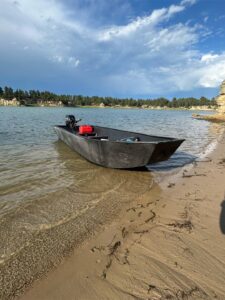
For operators replacing aluminum, the most common transitions we see are: jon boats and skiffs moving to HDPE jon boats; utility and patrol craft moving to HDPE workboats; and push barges, dredge tenders, and floating platforms moving to American-made HDPE barges.
Running the Replacement Decision
A defensible replacement case for a fleet manager or procurement officer usually rests on four documented items: a current ultrasonic thickness gauging report, two years of repair and downtime cost history, a crack inventory from the most recent haul-out, and a side-by-side total-cost-of-ownership model against at least one non-aluminum alternative. With those four documents in hand, the decision generally makes itself.
An aluminum workboat that has served well does not owe you anything. The question is whether continuing to operate it is the best use of your maintenance budget and crew hours — and whether the next hull you buy should be built from the same material that retired the last one.
For specifications, drawings, and pricing on HDPE replacement hulls, contact our team or request a quote through our online configurator.