Skip to content

When marine engineers evaluate hull materials for working barges, the conversation has traditionally centered on aluminum and steel. Over the past two decades, high-density polyethylene (HDPE) has moved from a fringe option to a mainstream choice for purpose-built workboats and barges, particularly in applications involving abrasion, impact, and long service intervals. This shift is grounded in measurable material science, not marketing. Understanding why HDPE performs the way it does on the water requires looking at the polymer’s mechanical behavior, the structural logic of a fusion-welded hull, and the design standards that govern thermoplastic vessel construction.
This article walks through the material data, the hull breakdown, and the published research that informs how a modern HDPE barge is engineered.
Why HDPE Earned a Place in Marine Engineering
When marine engineers evaluate hull materials for working barges, the conversation has traditionally centered on aluminum and steel. Over the past two decades, high-density polyethylene (HDPE) has moved from a fringe option to a mainstream choice for purpose-built workboats and barges, particularly in applications involving abrasion, impact, and long service intervals. This shift is grounded in measurable material science, not marketing. Understanding why HDPE performs the way it does on the water requires looking at the polymer’s mechanical behavior, the structural logic of a fusion-welded hull, and the design standards that govern thermoplastic vessel construction.
This article walks through the material data, the hull breakdown, and the published research that informs how a modern HDPE barge is engineered.
Why HDPE Earned a Place in Marine Engineering
HDPE is a semicrystalline thermoplastic with a density between 0.93 and 0.97 g/cm³, placing every part of the hull material below the density of fresh and salt water. The polymer’s structure of long, mostly linear chains gives it a combination of tensile strength, impact toughness, and chemical inertness that is unusual among commodity plastics. For a barge designer, the most relevant outcome is a hull material that resists abrasion, absorbs impact without permanent deformation, and does not corrode in any practical sense.
The shift toward thermoplastic hulls has been steady enough that classification bodies have published dedicated guidance. DNV’s class notes for craft now include provisions for thermoplastic vessels, and ABS has issued guidance on FRP and thermoplastic small craft construction. ISO 12215-5, which governs design pressures and scantlings for small craft hulls, has been adapted by manufacturers to validate HDPE plating and stiffener spacing through equivalent-stiffness calculations.
Material Properties That Drive Hull Performance
A useful way to read HDPE mechanical data is to compare it against aluminum 5086, the workhorse alloy for working barges in the same size class.
Density and effective buoyancy. At roughly 0.95 g/cm³, marine-grade HDPE floats. A one-inch-thick hull plate displaces more water than it weighs, which means a punctured compartment in an HDPE barge still contributes positive buoyancy. Aluminum 5086 sits at 2.66 g/cm³ and sinks on its own. This single property reshapes how compartmentalization and reserve buoyancy are calculated.
Tensile and yield behavior. Marine HDPE typically reports a yield strength in the range of 24 to 30 MPa under ASTM D638 testing, with elongation at break exceeding 600 percent. The polymer yields rather than fractures under overload, which is the opposite of how brittle composites or thin aluminum plates behave when struck. Krishnaswamy’s 2005 analysis of ductile and brittle failure modes in HDPE pipe (Polymer, Vol. 46) remains a useful reference for understanding why HDPE in a well-stabilized formulation almost always fails in slow ductile mode rather than rapid crack propagation when loaded within its design envelope.
Impact resistance. Notched Izod values for marine-grade HDPE under ASTM D256 commonly exceed 7 ft-lb/in, and the material retains useful impact strength down to roughly negative 40 degrees Celsius. For barges that beach on rock or ice, this matters more than headline tensile numbers.
Environmental stress crack resistance (ESCR). This is the property that separates commodity HDPE from marine-grade HDPE. Tested under ASTM D1693 or the more demanding PENT method (ASTM F1473), modern marine resins routinely exceed 1,000 hours without crack initiation. The Plastics Pipe Institute Handbook of Polyethylene Pipe documents how resin generations have advanced ESCR performance by orders of magnitude since the 1990s, and those same resins are now used in hull plate extrusion.
UV stability. HDPE itself is not UV-stable. Marine formulations include 2 to 3 percent carbon black, which absorbs UV across the relevant spectrum and protects the polymer chain. Field data from buried pipe applications, summarized by the Plastics Pipe Institute, shows projected service lives exceeding 100 years when carbon black is properly dispersed. Above-water hull exposure is less aggressive than the assumptions used in those projections.
Chemical inertness. HDPE resists hydrocarbons, salts, dilute acids and bases, and biological fouling. There is no galvanic corrosion path, no sacrificial anode requirement, and no paint system to maintain. This is covered in more depth on the HDPE material page.
Thermal behavior. HDPE has a coefficient of thermal expansion roughly ten times that of steel. Hull design accommodates this through stiffener spacing and avoidance of rigidly constrained spans. It is a design constraint, not a flaw, but it must be respected.
Hull Breakdown: What an HDPE Barge Is Actually Made Of
A modern HDPE work barge is not a single shell. It is a fusion-welded assembly of extruded sheet, structural stiffeners, and compartment bulkheads, designed so that load paths are continuous through welded joints rather than mechanical fasteners.
Bottom plating. Hull bottoms are typically built from HDPE sheet between 15 and 30 millimeters thick for barges in the 20 to 40 foot range. Thickness is selected to satisfy ISO 12215-5 equivalent-stiffness criteria for the design pressure of the operating area, with safety factors applied for abrasion and beaching wear. The bottom is generally flat or shallow-V, since HDPE’s abrasion resistance favors a configuration that accepts grounding as a normal event.
Side plating and freeboard. Side plates are usually thinner than bottom plates, in the range of 12 to 20 millimeters, since impact loads from floating debris are lower than bottom abrasion loads. The transition between bottom and side is a fusion-welded chine, with internal radius weld fillets that distribute stress across the joint.
Longitudinal stiffeners. Because HDPE has a Young’s modulus around 800 to 1,100 MPa, roughly one-seventieth that of steel, hull plates rely on closely spaced stiffeners to control deflection under load. Longitudinal stringers are fusion-welded to the inside of the hull bottom and sides, typically at 200 to 400 millimeter spacing depending on plate thickness and design pressure.
Transverse frames and bulkheads. Transverse frames intersect the longitudinals to create a stiffened panel grid. Full-depth bulkheads divide the hull into watertight compartments, and on barges these compartments are often sealed with air or filled with closed-cell foam. Foam filling shifts the failure mode from flooding to surface damage, since the hull cannot fill with water in any meaningful way.
Deck plating. Decks are integrated into the hull structure rather than bolted on. Top sheets are fusion-welded to bulkhead and frame top edges, creating a closed box girder along the length of the vessel. This box-girder behavior is what gives an HDPE barge its global longitudinal strength.
Fittings, bollards, and pushknees. Mooring hardware is either welded HDPE substructure with stainless or galvanized inserts, or bolted-through plate with backing pads sized to spread point loads. Any hard fitting is engineered to distribute load over a panel large enough that the plastic itself never sees concentrated stress.
The defining structural feature is that every primary joint is a fusion weld. HDPE butt fusion, performed under ASTM F2620 or ISO 21307 procedures, produces a joint that develops the full tensile strength of the parent material. There are no rivets to shear, no gasketed seams to leak, no welds to crack from fatigue at heat-affected zones. We cover the joining process in more depth in how HDPE pipe is most commonly joined, and the same physics applies at hull scale. The result is a hull that behaves as a single monolithic part.
How This Compares to Aluminum and Steel
The case for HDPE is not that it is stronger than metal. Per unit thickness, it is not. The case is that the system properties, hull weight, impact behavior, corrosion immunity, and joint integrity, produce a barge that holds up better under the conditions that actually wear out working vessels.
A 24-foot aluminum work barge and a 24-foot HDPE work barge will fall in roughly the same weight class when scantlings are matched for equivalent load capacity, because the HDPE structure uses thicker plate to compensate for lower modulus. The HDPE vessel will, however, tolerate repeated grounding without plate denting, will not require sacrificial anodes, will not need painting, and will not lose section to corrosion over its service life. For owners operating in shallow, rocky, or industrially contaminated water, these are the failure modes that matter.
Fiberglass, by comparison, fails by delamination and stress-cracking under the same impact and grounding events that HDPE absorbs ductilely. Steel barges remain the right answer above a certain displacement, where thermoplastic stiffness limits practical hull spans, but in the workboat and small barge range, HDPE has become competitive on engineering merit. The reasoning behind that competitiveness is laid out in why HDPE is ideal for plastic workboats.
Research and Standards Worth Knowing
For engineers and operators evaluating HDPE hulls, the literature is more developed than many realize:
- ISO 12215-5:2019, Small craft, Hull construction and scantlings, Design pressures for monohulls.
- ASTM D638, D256, D1693, F1473, and F2620, covering tensile, impact, ESCR, PENT, and fusion welding test methods.
- DNV class guidance for thermoplastic craft, which provides a classification framework for commercial vessels.
- The Plastics Pipe Institute Handbook of Polyethylene Pipe, which contains the most comprehensive published material data on modern HDPE resins.
- Krishnaswamy, R.K., “Analysis of ductile and brittle failures from creep rupture testing of high-density polyethylene (HDPE) pipes,” Polymer, Vol. 46, 2005, for understanding long-term failure mode behavior.
- ABS Guide for Building and Classing High-Speed Craft, which has been used as a reference framework for equivalent-stiffness validation of thermoplastic hulls.
These references collectively establish that HDPE in marine structural use is not experimental. It is a documented, standardized, and field-validated approach.
What This Means for Barge Operators
For a barge buyer, the practical implications of the material science are straightforward. The hull does not need painting. It does not need anodes. It tolerates grounding as a routine event rather than a service interval. Repairs, when needed, are made by extrusion welding using the same base resin, which restores the joint to full parent strength rather than patching it. Service life projections drawn from HDPE pipe data, where pressure-loaded HDPE has performed in service for 50-plus years, are conservative when applied to a hull that operates well below pipe-equivalent stress levels.
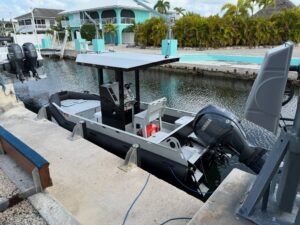
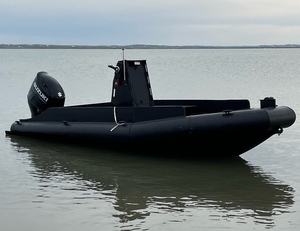
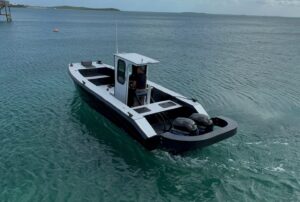
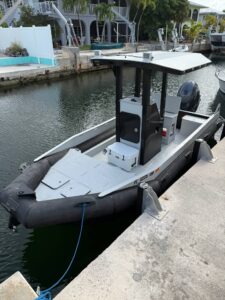
Legacy HDPE builds work barges in this construction class, including the T1230, T1645, 26 Barge, and the STS 24-40 Work Barge, each scantling-designed against the same material data discussed above. The full lineup of American-made HDPE barges reflects how this engineering plays out in production hulls.
Closing Note
HDPE earned its place in marine engineering by accumulating evidence, in material test reports, in classification standards, and in service hours on working vessels. For barge applications, where abrasion, impact, and corrosion are the realistic threats, the polymer’s behavior matches the failure modes the hull actually faces. That alignment is what makes the material a serious engineering choice, not a substitute.