Skip to content
Flood response in Wyoming runs through a patchwork of county and state resources rather than a single dedicated agency. The Wyoming Office of Homeland Security maintains eight Regional Emergency Response Teams based in Cheyenne, Casper, Jackson, Laramie, Rock Springs, Riverton, Worland, and Gillette, built to supplement local first responders when an incident outpaces what a county can handle on its own. [3]
At the county level, offices like Sweetwater County’s Emergency Management run dedicated water rescue and recovery teams, staffed largely by trained volunteers, equipped with boats carrying sonar, underwater cameras, and the gear needed for both search operations and dive recovery. [4]
These are capable, well-organized teams. What they’re not always equipped for is the specific punishment that floodwater puts on a boat, which is a different problem than the one most water rescue equipment was designed to solve.
Despite Wyoming’s reputation as a dry, inland state, those flood conditions occur more often than many people realize.
Wyoming’s Overlooked Flood Risk
Wyoming doesn’t flood the way coastal states do, which makes flood risk easy to underestimate.
Instead of hurricanes, flood events are often driven by rapid snowmelt after heavy winters. Twenty-one of Wyoming’s twenty-three counties carry elevated flood risk, yet only about one in 118 households in the state carries flood insurance. [1]
Unfortunately, the risk became undeniable in June 2023, when flooding in Natrona County was serious enough that the federal government issued a major disaster declaration for the state of Wyoming, opening public assistance funding for emergency work and facility repair tied directly to that event. [2]
The Dangers of Floodwater
A flooded river isn’t just a higher version of its normal self. Floodwater carries debris such as trees, fencing, vehicle parts, and other hidden hazards while often containing fuel, sewage, and agricultural runoff. It also hides the visual cues responders normally use to read a river, like sandbars, rock lines, and channel markers.
Not only does this make rivers more difficult to navigate, but hard contact with submerged debris becomes a near-certainty. As a result, a hull that handles normal river conditions well can take serious damage in a flood response scenario.
When aluminum hulls strike submerged debris, they can dent or even sustain structural damage that requires repair before returning to service. For agencies operating a limited number of rescue boats, losing even one vessel during an emergency can reduce response capacity when it’s needed most.
Contamination exposure can make the problem worse.
Repeated exposure to floodwater carrying fuel, chemicals, and other contaminants can accelerate corrosion-related wear on aluminum surfaces. Even if a boat doesn’t sustain any impact damage, a bad flood season can leave it noticeably worse for wear. [5]
What an HDPE Hull Changes
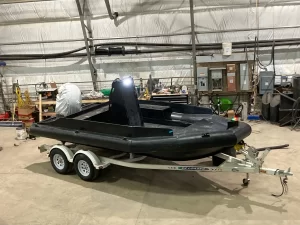
HDPE responds to floodwater conditions differently because the material properties line up with the specific risks flooding creates.
Impact recovery is the most immediate difference. In many impact scenarios, HDPE can flex and recover from strikes that would leave permanent dents in aluminum. A boat should be able to return to service without major structural repairs.
HDPE is also very buoyant. It’s less dense than water, which means a hull should stay afloat even if it’s damaged. [6] In flood conditions, where a boat is more likely to take an unexpected hit, that built-in margin is the difference between a rescue and a second incident.
Contamination resistance is the third factor, and it’s easy to overlook until you’re the one cleaning a boat after a flood response shift. HDPE’s non-porous surface doesn’t absorb fuel, sewage, or chemical runoff the way porous materials can. That means cleaning and maintenance after a rescue is much simpler.
And when something does need repair, you don’t need to haul the vessel to a marine yard. Many HDPE repairs can be completed using plastic welding techniques at a county maintenance facility. [7]
A Practical Note on Funding
For counties and agencies thinking about whether their current flood response equipment is adequate, it’s worth knowing that funding avenues exist specifically for this kind of preparedness investment. The Wyoming Office of Homeland Security currently has Hazard Mitigation Grant Program and Building Resilient Infrastructure and Communities funding open, with applications due June 23, 2026. [8]
Equipment that reduces flood response risk and downtime is squarely the kind of investment these programs are built to support, and it’s worth a conversation with your county’s emergency management coordinator before assuming a new vessel is out of reach.
The Boat Matters Most When You Can’t Predict the Conditions
Wyoming’s flood risk is real, documented, and consistently underestimated. The responders protecting their communities need equipment capable of operating in debris-filled, contaminated, and rapidly changing conditions.
Choosing a hull material that resists impact damage, contamination, and downtime can help ensure rescue boats remain available when communities need them most.
See the E23 Ember | See the 30-Foot Ember | Request a Quote
Sources
[1] FludZone. “Wyoming Flood Zone Lookup: FEMA Maps & Insurance.” Sourced from OpenFEMA NFIP Policies API, March 2026. https://www.fludzone.com/flood-zones/wyoming
[2] FEMA. “President Joseph R. Biden, Jr. Approves Major Disaster Declaration for Wyoming.” https://www.fema.gov/press-release/20230911/president-joseph-r-biden-jr-approves-major-disaster-declaration-wyoming
[3] Wyoming Office of Homeland Security. “Regional Emergency Response Teams.” https://hls.wyo.gov/programs/rerts
[4] Sweetwater County, WY. “Water Rescue/Recovery.” https://www.sweetwatercountywy.gov/departments/emergency_management_homeland_security/water_rescue.php
[5] Loyd Shipyard. “Steel, Aluminium, or HDPE: Choosing the Right Hull Material for Your Workboat.” https://www.loydshipyard.com/blog/steel-aluminium-or-hdpe-choosing-the-right-hull-material-for-your-workboat/
[6] Huariwin Boat. “The Unsinkable Advantage: HDPE Boats.” https://huariwinboat.com/high-density-polyethylene-boat/
[7] Legacy HDPE. “Can an HDPE Boat Be Repaired Easily?” https://legacyhdpe.com/can-hdpe-boat-be-repaired-easily/
[8] Wyoming Office of Homeland Security. “Hazard Mitigation and BRIC Funding Available.” https://hls.wyo.gov/