Skip to content

When your work is based on performance on the water, the decision to choose a workboat is not a “purchase,” it is a strategy! Having the right HDPE (High-Density Polyethylene) workboat can make all the difference between trustworthy performance and trouble caused by costly downtime, regardless of your business, from aquaculture to construction, environmental services, or patrol work.
At Legacy HDPE, we understand every business has different needs, and the workboat you select should be specifically tailored to those needs. But how do you ultimately select the correct one that works for you? Let’s figure this out.
1. Understand What Your Operational Needs Are
First start by understanding how and where you will use the boat. HDPE workboats are known for their durability, buoyancy and high resistance to corrosion, but that does not mean one size fits all.
It is important to ask yourself:
- What type of work will you be performing on the boat: transport work, inspection work, cleaning work or heavy-duty work?
- Will your workboat operate in calm inland waters, coastal zones, or open sea?
- What’s the crew size or required equipment payload?
Understanding your daily surroundings begins to guide you toward selecting the proper hull configuration, deck plan, and propulsion. For example, a shallow draft model may be best suited to aquaculture and nearshore use, and a deeper or V-hull configuration is typically more appropriate for offshore use.
2. Assessing Design and Build Quality
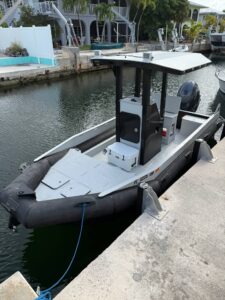
One of HDPE’s biggest advantages is that it takes a beating and keeps going. Unlike aluminum and fiberglass, it won’t corrode, dent, or crack easily. However, not all builds using HDPE are the same.
For design assessments, you should look for the following:
- Seamless welding and structural integrity: Not only will these be attributes of strength, but they are critical to safety and sustainability over time.
- Deck configuration & space utilization: Ensure the deck configuration is configured for the best workflow and setup of equipment.
- Stability & buoyancy: HDPE provides natural flexibility and shock absorption, which is favorable in difficult conditions; however, it is still worth looking at any specifications that impact balance and handling.
Legacy HDPE strives to build every workboat based on project-specific parameters for a significantly better overall balance of durability, performance, and utility.
3. Think About Customization and Long-Term Value
Businesses evolve, and your vessel should be able to evolve with it. This is why customization options are important. Whether you need reinforced decks to hold heavy equipment, extra seating for crews, or a specific cabin arrangement, having the option to customize your workboat means getting the most value out of it during its lifetime.
Also think about maintenance and lifecycle costs. HDPE boats have less maintenance than many other materials; no painting, no corrosion treatments, and easy, in some cases, after-market repairs. This translates into less ownership cost, and less downtime for your team.
A quality manufacturer can not only help you design the boat in the beginning, but can also support you. As your operation needs additional service and upgrades over time, and this is something we take great pride in providing at Legacy HDPE.
Let’s Recap
Buying the right HDPE workboat is about more than specifications and information. It is about creating a tool that works as hard as you. Whether you’re growing your fleet, or buying your first boat, Legacy HDPE will help you design, build, and choose the best HDPE workboat for your business!
Call our team today to consider our options of HDPE workboats that will get you started in the direction of shaping your next vessel which powers your business.